ME 2.0: A Tale of Cloning and Consequence
In the year 2042, medical advancements had soared to incredible new heights, far surpassing the technology of the early 2020s.
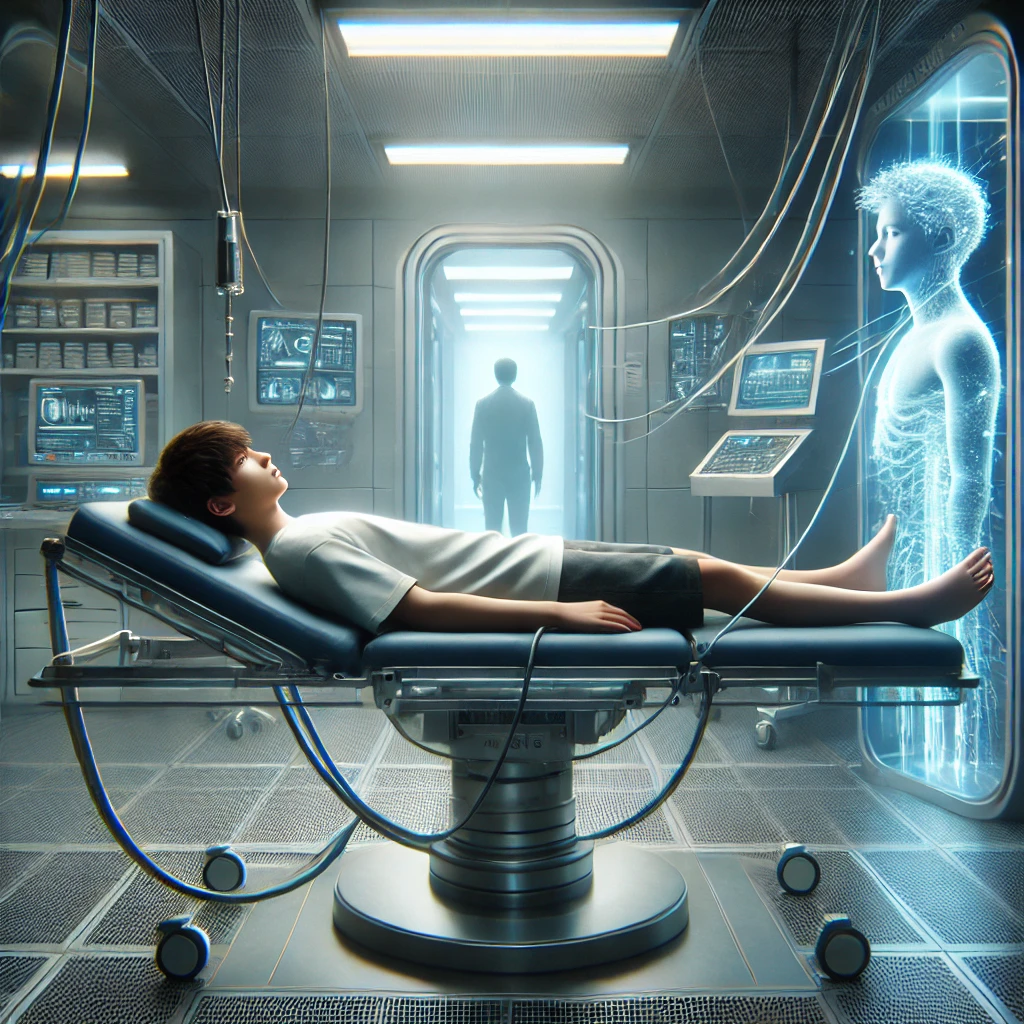
The most revolutionary of these breakthroughs was the ME2.0 program—a groundbreaking technology that allowed individuals to purchase and use physical clones of themselves!
Known to everyone simply as “Doppelgängers,” these clones offered a chance at a new life—a better life—for anyone, from the old and fragile to the severely injured or terminally ill.
All that was required was a Doppelgänger to transfer your conscious mind into.And that wasn’t all.
These new bodies weren’t just similar—they were better!
Healthier, stronger, and way more resilient too!
These new bodies weren’t just a second chance; they were an upgrade, a promise of a better, stronger, longer, healthier life!
The allure was undeniable—after all, who wouldn’t want to trade in their aging, ailing body for a newer, better one?
For someone like me, Kenji Thompson, a sixteen-year-old who had once led an active life filled with football, skateboarding, and hanging out with friends—it felt like a miracle!
A chance to get back everything I had just lost!
One day, I didn’t have a care in the world, just enjoying the next big adventure. The next, a totally unexpected freak car accident left me with a broken back—and paralysed for life.
Or at least that would have been the case without the existence of the ME2.0 program.
My parents, Emily and David, were shattered by the news. The doctors told them I was lucky to be alive, but for me, it felt like a cruel joke.
My body, once so full of life and energy, had become a prison. The future I had imagined—a future filled with movement, freedom, and independence—had been obliterated.
It was my mother, Emily, who first brought up the ME2.0 programme. Her voice trembled with a mix of hope and fear as she explained it to me.
The idea seemed almost too good to be true: transfer my consciousness into a new, fully functional body—a body that was not just a copy, but an improved version of my old self.
Faster, stronger, healthier. The decision was made quickly. Neither my parents nor I could bear the thought of a half-life, trapped in a wheelchair, reliant on others for even the simplest of tasks.
Within weeks, the process was set in motion. The doctors assured us it was safe—a routine procedure they had performed countless times before.
My mind would simply move from one vessel to another, they said. It was as easy as moving house. And yet, despite their reassurances, a small doubt gnawed at the back of my mind.
What would happen to the part of me that was left behind? The day of the transfer arrived with a strange mix of excitement and dread.
As I lay on the operating table, my old body strapped down, I couldn’t shake the feeling of unease. The thought of leaving my old self behind, like an empty shell, made my stomach churn.
But there was no turning back now. The procedure began. I felt an odd sensation, as if I were being pulled out of my own skin. There was a moment of disorientation, a brief flash of darkness, and then—nothing.
But what I didn’t know was that the process was interrupted. Just as the transfer was beginning, a group of protesters broke into the ME2.0 facility, intent on destroying what they saw as an affront to nature and human dignity.
In their attempt to sabotage the programme, they caused a temporary power cut midway through the procedure, before the backup generators could kick in.
This critical interruption meant that the transfer was incomplete.
When I opened my eyes again, I was in a new body. Everything felt the same, yet different. My limbs responded to my commands with ease, my senses were sharper, and my mind was clearer than ever.
I was still me, but better in every possible way.
It was everything I had hoped for, and more.
For a while, life seemed to return to normal. I went back to school, reconnected with my friends, and resumed my old hobbies.
My parents were overjoyed to have their son back, whole and healthy.
My best friend, Alex, couldn’t stop grinning when he saw me for the first time in my new body.
“It’s like you never left, mate,” he said, clapping me on the back. “You’re even better than before!”
I laughed, feeling a surge of gratitude. “Missed you too, man. It’s good to be back.”
But as the weeks passed, a disquieting feeling began to grow. It started with small things—moments of confusion, memories that didn’t quite fit.
Friends would mention events I had no recollection of, claiming I had been there when I knew I hadn’t.
At first, I brushed it off, thinking it was just a side effect of the transfer. But the inconsistencies began to pile up.
People started accusing me of things I hadn’t done—arguments I didn’t remember, places I hadn’t been to.
One evening, Alex pulled me aside after school.
“What’s going on with you, Kenji? You’ve been acting so damn strange lately. One minute you’re totally normal, and the next, you’re like a completely different person!”
His comments caught me off guard. I had no idea what he was talking about, but his concern was evident. Still, I tried to dismiss it, even as the nagging feeling inside me grew stronger.
As the days passed, the lapses in my memory became more and more frequent. It was as if I were watching my life through a fogged-up window—seeing the outline, but unable to grasp the details. And then, one night, everything came crashing down.
I was lying in bed, staring at the ceiling, trying to piece together the fragments of my day when I heard a noise downstairs.
It wasn’t the usual creaks and groans of the house; this was different. Footsteps—soft, deliberate, moving towards my bedroom door.
My heart began to race, a cold sweat breaking out on my skin. I sat up, straining to listen, my mind whirling with possibilities.
Perhaps it was one of my parents checking in on me. But something about the sound made my blood run cold.
I slipped out of bed as quietly as I could, inching towards the door, and slowly turned the handle.
What I saw on the other side made my blood freeze. It was me. The old me. The body I thought had been disposed of, the one that was supposed to be lifeless and gone forever.
But there it was, standing in the dim light of the hallway, staring back at me with hollow, empty eyes—my old face twisted into a mask of rage and despair.
My breath caught in my throat as the horrifying truth dawned on me. My old body hadn’t died.
Somehow, despite the incomplete transfer, it had retained some fragment of consciousness—enough to claw its way back. And now, it was here to reclaim the life I had taken from it.
The old Kenji—my old self—looked at me with a fury that was beyond comprehension. Blood dripped from its mouth—he had literally bitten off his own tongue!
Without a word, he lunged at me, knocking me to the ground. I tried to fight back, but the old body was relentless, fuelled by a dark, desperate rage that overpowered me in seconds.
The air rushed out of my lungs as the old me pinned me to the floor, its hands closing around my throat.
The last thing I saw before everything went dark was my own face, twisted in hatred, staring back at me.
When I came to, the room was eerily quiet. I tried to move, but I couldn’t. My vision was blurry, and everything around me seemed distorted, as if I were seeing the world through a thick veil.
Slowly, painfully, I realised what had happened. The old me had won.
My consciousness had been ripped away from the new body and thrust back into the old, broken shell I thought I had escaped.
The new body—my better, stronger self—was lying motionless beside me, its eyes wide open but lifeless.
I was trapped, paralysed, watching my parents mourn over the body they believed was me, while my consciousness lay buried in the broken shell of my former self.
The second chance I had been given was nothing more than a cruel illusion, a nightmare from which I would never wake.
The next morning, my parents found the lifeless body of the new Kenji. They screamed in horror, not understanding what had happened.
The police arrived, and an investigation was launched, but no one could make sense of the scene.
Eventually, the truth came out—about the ME2.0 programme, the mind transfer, the Doppelgänger, and the terrible mistake that had been made.
Although the protesters were ultimately to blame for the glitch, the ME2.0 programme couldn’t escape scrutiny. The world was horrified, and the entire programme was immediately shut down—suspended indefinitely, and ultimately banned worldwide.
But none of that mattered to me. I was a prisoner in my own flesh, left to die in a body that no longer functioned.
My parents would sit by my bedside, holding my hand, unaware that I was still there, trapped in a body that would never move or speak again.
They’d chat about the old days, about how full of life I had been, how they had tried everything to save me. They would cry, and I would scream as loudly as I could, begging for someone to hear me – to help me – but no one ever would.
THE END
**********
Author’s Thoughts
The thought that stays with me is being in the room while people mourn you—and being unable to tell them you’re still there.
Hearing their voices. Feeling a hand around yours. Trying with everything you have to make one finger move.
Kenji wants the freedom he remembers. His parents want to help their son. That hope makes the promise of ME 2.0 easy to understand.
But what happens to the person left behind?
If both versions remember the same childhood, love the same people and feel the same fear, which one gets to say, “This is my life”?
For me, the horror begins when someone decides that one of them no longer counts.
We spend so much time wondering whether technology could preserve who we are. Perhaps we should also ask how we would recognise someone still waiting to be seen.
Just something to think about.